

If you are reading this blog post, you may be looking for the answer to: Why do I binge eat? How do I stop?
In this blog post, I will explore one common factor that can contribute to binge eating – restriction – and offer some starting points for understanding and changing the binge eating cycle.
Why do I binge eat? What fuels the desire to binge?
Binge eating can often be fuelled by deprivation – not only physical restriction of calories and nutrients, but also emotional and psychological deprivation.
Our brain is wired for survival. The reptilian brain, the oldest part, controls survival instincts that were crucial in ancient times. Food restriction and dieting are perceived by the brain as starvation or famine.
These days, we may not need our brain to be on high alert for food, as (in the Western world) we don’t face scarcity and are surrounded by food. But our survival instincts remain active. When we cut back on food, our brain’s survival mechanisms kick in, making us overly fixated on food and leading to obsessive thoughts and a lack of focus.
This is a natural brain response to food restriction. Even if you tell yourself, ‘There is food. I can eat it later. Right now, I don’t need more food as I am trying to lose a few kilograms’, your brain won’t acknowledge this. Survival mechanisms are much stronger than thoughts.
At some point, when food is within close reach, your brain will scream to have it now. It is here, you must eat it, as there may be scarcity again soon. The brain is protecting your survival like it did millions of years ago and will continue to do so.
For some people, this is when a binge can happen: the urge to eat becomes intense, fast and difficult to control. When we limit the intake of food, we also limit the intake of essential nutrients and electrolytes. Our body requires around 30 different micronutrients every day. It’s likely you will crave and binge on high-calorie, high-fat, high-sugar food, as this is the quickest way for the body to replenish the calories and nutrients lacking during the restriction.
Why and When Did the Trend to Restrict Start?
Where have the desire to restrict ourselves is coming from?
The first diet book has been published back in 16th century. The concept of “ideal body types” emerged in the mid-1800s, with beauty becoming increasingly associated with the appearance of one’s body. I recommend reading this article, which goes deeper into the history. It shows how the diet culture with its stigmatisation of body weight and the promotion of food restriction have been supported to maintain systems of power and oppression.
Why Dieting Often Keeps the Binge Cycle Going
Diet culture often offers an illusion of control, while placing the blame on the individual when the diet does not work long term. The diet gives us an unrealistic promise of losing X kgs and Y cms in Z days if we follow specific instructions. There are many different diets out there – Dukan, Atkins, Keto, low-carb, Not-eating-after-6pm diet, etc. If we don’t achieve the XYZ results, it is our fault for not following the instructions.
But how can one instruction fit every body? Manuals are great for electronic devices, but we are not robots.
Here are a few reasons a diet can’t bring the same results to everyone:
- We all have a genetically predetermined weight set point, similar to eye colour or facial features. Constantly fighting to lower this set point can lead to an ongoing battle with your body.
- Our energy needs vary daily based on activity levels. For women, this is also important as our cycle dictates us to need more calories on certain days.
- Metabolic rates differ from person to person.
- We all have different reactions to food restriction. Some of us will be more sensitive and will develop obsessive thoughts about food, leading to compulsive eating and bingeing.
- Studies have found a genetic link to eating disorders. Some people have a genetic predisposition to develop binge eating, anorexia nervosa, or bulimia. They have higher chances of developing eating disorders if triggered by deprivation, environment, and other psychological reasons.
I hope this list shows how diet is set to fail from the start, and also can be harmful.
Two Major Consequences of Long-term Dieting
I see two major problems with long-term dieting:
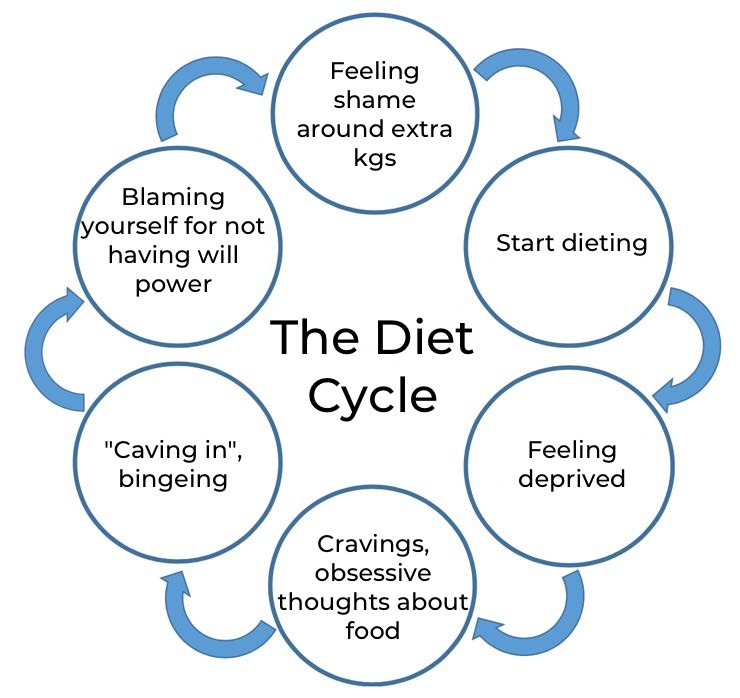
One – it hands over the decision-making process for your health to someone else (the Diet, the Instruction). Following the manual only requires one decision – commitment to follow the diet. In reality, long-term commitment to your health and wellbeing requires being in touch with your body and mind, and making small decisions every day. It doesn’t mean you should throw out any structure around food – I will discuss the role of structure later below.
Two – it feeds the self-blame cycle, which adds fuel to the binge eating cycle:
How Do I Stop Binge Eating?
Healing from binge eating requires a holistic approach. Our body and mind have a strong connection; therefore, wellbeing involves taking care of both physical and mental health.
1. Establishing Regular Eating
The first step to breaking this vicious cycle is to stop restricting your eating. Ideally, we want to eat intuitively, which means eating to satisfy our body’s needs every day. However, in people with eating disorders, the connection between body and mind has been broken. Often it is difficult for them to understand when they are hungry or full. A big part of my work with clients is restoring the body-mind connection by cultivating mindfulness. It takes time. Therefore, we focus on hunger and fullness much later in our work together.
Meanwhile, we establish consistent meal intake. I often use Marcia Herrin’s protocol with three consistent meals and two snacks. Consistent eating reduces the chances of bingeing, as your brain’s survival instinct will be calmed down by regular food intake.
2. Getting Rid of the ‘Prohibited Foods’ List
Often, regular eating requires mindset work on ‘legalising’ specific products. For example, if desserts or spaghetti Bolognese have been on your list of prohibited meals because they are high in calories, we will work on allowing yourself to eat these meals during structured mealtimes. This method takes away the scarcity mindset and reduces extra attention around specific products, making them much less attractive as they become a normal part of your meals.
This takes time as often eating ‘prohibited’ products brings anxiety about gaining weight, especially if you have body dysmorphia or unrealistic body image goals. Having the support of a trusted friend, close family member, therapist, or coach is very important if allowing yourself to eat brings anxiety.
3. Rebuilding Trust With Your Body
Being active can support health and emotional wellbeing, but in recovery it is important to notice the intention behind movement. Is movement used as punishment for eating, a way to compensate, or another rule to obey? Or can it become a way of gently reconnecting with the body?
Rebuilding trust with the body often means learning to listen again: to tiredness, hunger, fullness, energy, pain and the need for rest. This does not happen instantly, especially if the body has been treated for a long time as something to control. It takes time to move from punishment to relationship.
4. Understanding Shame and Body Image
Binge eating is often surrounded by shame. Shame about eating. Shame about the body. Shame about ‘losing control’. But shame rarely helps us change. More often, it keeps the cycle hidden.
In recovery, it can be important to explore how your body image has been shaped: by family messages, culture, relationships, social comparison, diet culture and earlier experiences of being judged or not feeling acceptable.
This does not mean you have to love every part of your body or abandon all wishes for change. It means beginning to relate to your body with more honesty and less punishment. Life is happening now, not only in the future when you may be a few kilos lighter.
How Therapy or Coaching Can Support Binge Eating Recovery
Binge eating is rarely only about food. Food may become a way to manage feelings, soothe distress, fill emptiness, express rebellion against restriction, or find comfort when something feels too much. This does not mean the binge is “bad” or that you have failed. It means the behaviour is trying to do something for you, even if it is also causing distress.
Therapy can offer time and space to explore what food, body image and eating patterns may mean in your life. We might look at the emotional cycle around binge eating: what happens before, during and after a binge; what feelings are difficult to stay with; how shame affects the cycle; and how your relationship with your body has been shaped by family, culture, diet culture, relationships and earlier experiences.
Coaching may be helpful if you are looking for a more focused and practical approach. In coaching, we can work towards a specific goal, such as establishing regular eating, reducing restriction, building structure around meals, understanding triggers, and creating small, realistic steps with accountability. The number of sessions you need depends on your goal and the kind of support you are looking for.
If you would like to explore this more deeply, you may want to read about how I work on my Psychotherapy & Counselling page. If you are looking for a more targeted, goal-focused approach, you can read more on my Coaching page. You are also welcome to contact me for an initial conversation, so we can think together about what kind of support may feel right.