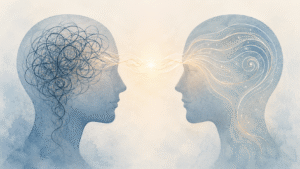

Becoming a mother changes a woman at every level: body, brain, relationships and sense of self. There is a word for this transition to motherhood: matrescence. Coined by the anthropologist Dana Raphael in the 1970s and brought into wider public conversation by the writer Lucy Jones in her book Matrescence, it names a developmental passage as profound as adolescence. Yet maternal mental health during this passage has been strangely neglected, hidden behind the comfortable idea that motherhood is simply ‘natural’. If you are a mother who feels torn, guilty or quietly unlike yourself, let me say this first – very little of what you are feeling is a personal failing.
Why maternal mental health in matrescence has been overlooked
Lucy Jones writes with real frustration about the pregnancy books she read – pages on the size of the baby comparing to fruits, what to buy and what to avoid, and almost nothing about what was happening to her. She goes further – the silence around the maternal experience is not accidental. It is a form of misogynistic oppression. When the transformation is framed as instinctive, a woman who finds it disorienting concludes that something is wrong with her.
The evidence says otherwise. In the UK, as many as one in five women experience a mental health challenges during pregnancy or in the first year after birth, and suicide is the leading cause of direct maternal death between six weeks and a year after birth. That is not what a natural process looks like. It is what neglect looks like.
Matrescence research: how pregnancy changes the brain and body
The research we do have is recent and striking. In 2017, neuroscientist Elseline Hoekzema and colleagues showed that pregnancy produces marked changes in the mother’s brain, concentrated in regions involved in understanding other minds, and still visible two years later. The maternal brain is, in effect, rebuilt for relationship.
The body keeps its own record. During pregnancy, cells from the baby cross the placenta and stay. Foetal cells have been found in mothers’ blood almost three decades after birth, and a 2012 study found male DNA, most likely from sons, in the brains of most of the women examined, including one aged 94. Nobody yet knows what these cells do. But sit with the fact itself – a mother carries her children in her tissues for life. If the biological change is this deep, why would the psychological and relational change be any smaller? And why so little study? Partly because women were largely excluded from medical research until the 1990s, and pregnant women mostly still are. Partly because what mothers go through has been treated as private and unremarkable.
Patriarchy, self-sacrifice and the shame placed on mothers
Adrienne Rich wrote about the difference between motherhood as lived experience and motherhood as an institution: the patriarchal rules and expectations that shape what a ‘good mother’ is allowed to feel, want and become. Longstanding patriarchal ideals measure a ‘good mother’ by her willingness to sacrifice herself – she is endlessly available, instinctively attuned, grateful and untroubled. She sacrifices herself and does not mention the cost. Modern expectations add professional success, financial contribution and a fulfilling relationship, often without redistributing care. Jones’s work helps expose how these demands are socially constructed. The sociologist Sharon Hays called the modern version ‘intensive mothering’, now stacked on top of the expectation that women will also work, keep friendships alive and stay interesting to their partners.
Shame can turn an impossible expectation into a judgement about who you are. Shame is what keeps the rules in place. Wanting solitude becomes ‘selfishness’, admitting resentment feels like confessing that you do not love your child enough. Repeated through families, advice and media, these messages can become an internal voice that sounds like your own. Mothers are shamed for working and for not working, for wanting time alone, for feeling anything other than gratitude. The psychotherapist Rozsika Parker observed that what mothers hide most carefully is ambivalence: love and resentment towards the same child. Even Donald Winnicott wrote, in 1949, that every mother has good reasons to hate her baby at times. Ambivalence is not a flaw in your love. It is its normal texture.
Postnatal care in the UK: fewer midwife visits and vanishing support
Support in the UK has been thinning for years. England has lost more than 40% of its health visitors since 2015, and over a thousand Sure Start children’s centres have closed since 2010. With them went baby-weighing clinics and drop-ins, where a tired mother could sit among other mothers without needing a reason, and simply be seen. Midwife home visits have shrunk to a few contacts, some by phone, and women are often discharged within hours of giving birth. The 2024 Birth Trauma Inquiry, drawing on more than 1,300 women’s accounts, concluded that postnatal care was almost universally poor.
When services disappear, the need does not. It is transferred to the individual mother, who then experiences a structural gap as personal anxiety. Yet the anthropologist Sarah Blaffer Hrdy has shown that humans evolved to raise children cooperatively, with many hands. A mother alone in a flat with a newborn is not the natural state. It is a recent and unusual one.
Working mothers – guilt and the feeling that you cannot win
Many of the women I work with are building careers as well as families, and they describe a bind with no exit. Step back from work, and there is resentment, a shrinking sense of self and ambition that goes underground and turns sour. Protect the work, and there is guilt and a low, persistent fear of damaging the children. Both routes arrive at the same verdict: I am failing.
Psychological ideas can add to this burden. Attachment theory developed within a profession historically dominated by men (although Mary Ainsworth was a foundational figure alongside John Bowlby). It was popularised in post-war Britain in a way that made the mother the sole guarantor of a child’s future. Yet the research itself points elsewhere. Babies form secure attachments to several people, not one.
Ed Tronick found that even attuned mothers and infants are out of step around 70% of the time; what builds security is repair, not perfection. A meta-analysis of 69 studies found no overall harm to children’s achievement or behaviour from mothers working in the early years. And Bowlby himself wrote that ‘if a community values its children it must cherish their parents’. That sentence was somehow left out of the advice given to mothers.
Challenging our internal voices
The bind of motherhood cannot be resolved by one woman trying harder. So much of what mothers carry have been made private, as if guilt, exhaustion, resentment or loss of self are individual failures. But these feelings do not grow in a vacuum. They grow inside long histories of what women have been told a ‘good mother’ should be.
This is why shame in motherhood can feel so intimate and so familiar. It often sounds like our own voice, but it may not have started there. It may carry the voice of culture, family, religion, class, patriarchy, old ideas about femininity, and the mothers before us who also had to survive by asking for less.
I think part of the work is learning to recognise these voices before we obey them. These voices need to be challenged, not only quietly inside ourselves, but in the way we speak to one another. Mothers need places where the truth can be said without being turned into blame. That someone can love her child and still miss her old life. That she can be devoted and bored, grateful and angry, tender and full of longing. That she can want to work, create, earn, think, rest, be touched, be alone, be desired, be seen as more than useful. None of this makes her less of a mother. It makes her human.
And perhaps this matters for our children too. I do not think we want our daughters to learn that motherhood means disappearing. I do not think we want our sons to grow up believing that women’s invisible labour is simply the natural order of things. The way we speak about mothers becomes part of what children absorb about love, care, gender, sacrifice and whose needs matter.
Of course, individual women cannot rebuild the whole system alone. We cannot personally restore children’s centres, redesign parental leave, make childcare affordable, close the gender pay gap, or bring back the village that so many mothers were meant to have. And this matters, because many women who want to work still find themselves stepping back. Not because they have no ambition, but because when childcare costs are placed against two unequal salaries, the mother’s work is often the one treated as less worth protecting. What looks like a private family decision is also shaped by unequal pay, policy, and long cultural ideas about whose career matters more. But we can stop treating maternal distress as a private weakness. We can stop shaming other women for the compromises they have had to make. We can ask more from partners, families, workplaces and society than admiration for maternal sacrifice.
Peace with the compromises of motherhood does not come from finally getting the balance right. It comes from accepting that no right balance exists, and choosing anyway, with open eyes. And maybe peace begins there: not in becoming a perfect mother, not in removing guilt forever, but in refusing to disappear from your own life.
You are going through one of the most significant transformations a human being can undergo, largely unsupported, and still showing up. That deserves tenderness, from others and from yourself. You do not have to disappear to be a loving mother. Your needs belong in the family picture too.